Deuteranomaly
In deuteranomaly the green-sensitive (M) cones are present but their sensitivity is shifted towards the red-sensitive cones. Red and green signals become more similar, so some reds, greens, browns and oranges are harder to tell apart. It ranges from barely noticeable to fairly strong.
Deuteranomaly is the milder, more common form of deutan color blindness (sometimes called green-weak color vision). The complete form is deuteranopia.
Red-green color vision deficiency · Last updated 2026-11-10
What does deuteranomaly look like?
 Typical color vision
 Simulated moderate deuteranomaly
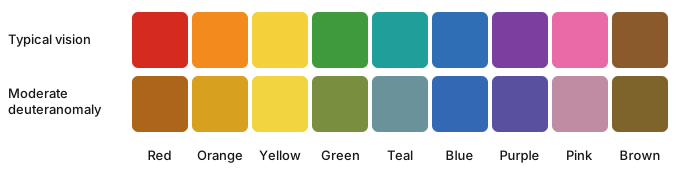
- Greens, yellows, oranges and reds can look more alike, especially in dim light or small areas.
- Muted colors are harder than bright, saturated ones.
- Many people with mild deuteranomaly don’t know they have it until they take a test.
Try our color blind simulator to see your own photos the way someone with a deutan deficiency might.
How common is deuteranomaly?
About 5% of men and roughly 0.4% of women of Northern European ancestry, making it the most common color vision deficiency.
Everyday situations that can be tricky
- Telling ripe from unripe fruit, or rare from cooked meat.
- Reading charts, maps and status lights that rely on red versus green.
- Matching clothes (e.g. brown versus green, purple versus blue).
Causes
It is almost always inherited through the X chromosome (variants in the OPN1MW/OPN1LW gene array), which is why it is far more common in men. It is present from birth and does not get worse over time.
Deuteranomaly vs deuteranopia
Both are deutan types: they involve the green-sensitive (M) cones. In deuteranomaly those cones are present but shifted toward the red-sensitive cones, so some red-green discrimination remains and severity ranges from mild to strong. In deuteranopia the green-sensitive cones are missing or not working, so colors along the red-green axis collapse much more. A plate test can suggest which is more likely; eye care professionals use an anomaloscope to tell them apart.
Read more about deuteranopia.
Glasses, apps and other aids
Color-enhancing glasses with notch filters can increase the contrast between reds and greens for some people with deuteranomaly. They do not restore normal color vision and results vary from person to person. What the studies found, type by type: do color blind glasses work?
Phone and computer accessibility settings (color filters), color-identifier apps, and asking for labels or patterns on color-coded information can all help. There is currently no approved cure for inherited color blindness.
How is deuteranomaly diagnosed?
Eye care professionals use plate tests (such as Ishihara or HRR plates), arrangement tests and, for a precise diagnosis, an anomaloscope. Online tests like ours can flag a likely deficiency but can’t replace a clinical test.