Tritanopia

In tritanopia the blue-sensitive (S) cones are missing or not working. Blue and green look similar, yellow can look pink or light gray, and purple can look like red. Red-green vision is usually normal.

Tritanopia is the complete form of tritan color blindness, usually called blue-yellow color blindness. The milder form is tritanomaly.

Blue-yellow color vision deficiency · Last updated 2026-11-10

What does tritanopia look like?
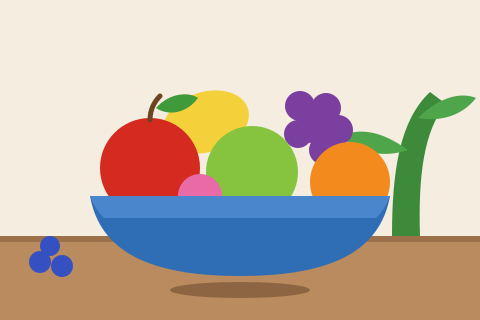
Illustration of fruit in a blue bowl with typical color vision: red apple, green apple, yellow lemon, orange, purple grapes, pink peach and blueberries.Typical color vision
The same fruit bowl simulated with tritanopia. The blue bowl turns teal and sits close to the greens, yellow turns pale pink, orange looks coral and purple turns a muted mauve. Reds stay red.Simulated tritanopia
The blue bowl turns teal and sits close to the greens, yellow turns pale pink, orange looks coral and purple turns a muted mauve. Reds stay red.
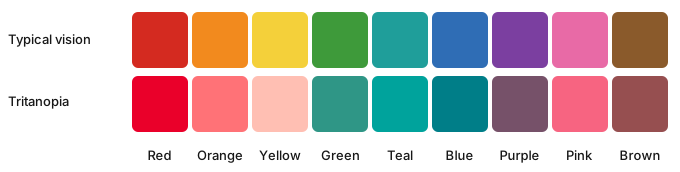
Nine color swatches (red, orange, yellow, green, teal, blue, purple, pink and brown) with typical vision and simulated with tritanopia.
Common colors with typical vision (top) and simulated tritanopia (bottom). Images are simulations based on the Machado, Oliveira & Fernandes (2009) model; real experience varies from person to person and with your screen.
  • Blue and green look alike.
  • Yellow can appear pinkish, light gray or white.
  • Purple and red can look similar.

Try our color blind simulator to see your own photos the way someone with a tritan deficiency might.

How common is tritanopia?

Very rare when inherited (roughly 1 in 30,000 to 1 in 50,000 people); affects men and women equally.

Everyday situations that can be tricky

  • Reading blue-on-green or yellow-on-white information.
  • Recognizing colors in nature, such as the sky versus foliage.

Causes

It can be inherited (autosomal dominant, OPN1SW gene), but acquired blue-yellow defects from eye disease, diabetes, glaucoma, cataract or medication are more common. If you have noticed a change, see an eye doctor.

Tritanopia vs red-green color blindness

Red-green types involve the red- or green-sensitive cones and are inherited on the X chromosome, so they mostly affect men. Tritanopia involves the blue-sensitive cones, is inherited in an autosomal dominant pattern, and affects men and women about equally. Red-green color blindness is far more common.

Read more about deuteranopia.

Glasses, apps and other aids

Color-enhancing glasses are not designed for tritanopia. What the studies found, type by type: do color blind glasses work?

Phone and computer accessibility settings (color filters), color-identifier apps, and asking for labels or patterns on color-coded information can all help. There is currently no approved cure for inherited color blindness.

How is tritanopia diagnosed?

Eye care professionals use plate tests (such as Ishihara or HRR plates), arrangement tests and, for a precise diagnosis, an anomaloscope. Online tests like ours can flag a likely deficiency but can’t replace a clinical test.

Take the tritanopia test

Tritanopia FAQ

What is blue-yellow color blindness?

It is the common name for tritan color vision deficiency: tritanopia (blue-sensitive cones missing or not working) and tritanomaly (blue-sensitive cones working abnormally). Despite the name, the main confusion is blue with green.

What colors can people with tritanopia see?

People with tritanopia still see color. The main confusions are blue with green, yellow with pink or light gray, and purple with red, and colors can look less bright overall. Reds generally stay distinct.

How rare is tritanopia?

Inherited blue-yellow color vision deficiency is rare: MedlinePlus estimates fewer than 1 in 10,000 people worldwide. It affects men and women equally.

Is tritanopia genetic?

It can be. Inherited tritanopia is linked to variants in the OPN1SW gene and passed on in an autosomal dominant pattern, so one altered copy can be enough. Blue-yellow changes are also often acquired from eye disease, diabetes, cataract or some medications.

Is there a tritanopia filter?

Yes. Our color blind simulator applies a tritanopia filter to your own photos in the browser, so you can see roughly how an image looks with tritanopia.

Other types of color blindness

See all types of color blindness compared side by side, or what colorblind people see with each type.

Sources

  1. National Eye Institute. Types of color vision deficiency. nei.nih.gov
  2. MedlinePlus Genetics, U.S. National Library of Medicine. Color vision deficiency. medlineplus.gov
  3. Weitz CJ, Miyake Y, Shinzato K, et al. Human tritanopia associated with two amino acid substitutions in the blue-sensitive opsin. Am J Hum Genet. 1992;50(3):498–507. pmc.ncbi.nlm.nih.gov
  4. Simunovic MP. Colour vision deficiency. Eye. 2010;24(5):747–755. pubmed.ncbi.nlm.nih.gov
  5. Machado GM, Oliveira MM, Fernandes LAF. A physiologically-based model for simulation of color vision deficiency. IEEE TVCG. 2009;15(6):1291–1298. (Used for the simulated images.) doi.org

Note: this is a screening, not a diagnosis. Online tests can’t control your screen’s colors or brightness, so confirm any result with an eye care professional. Medical disclaimer · How the test works

More color vision tests