Deuteranopia
People with deuteranopia have only two working cone types: red-sensitive (L) and blue-sensitive (S). Colors that differ only in how much they stimulate green cones look identical, so a whole range of reds, oranges, yellows and greens collapse into similar yellowish-brown tones.
Deuteranopia is the strongest form of deutan color blindness, also called green-blindness. The milder, more common form is deuteranomaly.
Red-green color vision deficiency · Last updated 2026-11-10
What does deuteranopia look like?
 Typical color vision
 Simulated deuteranopia
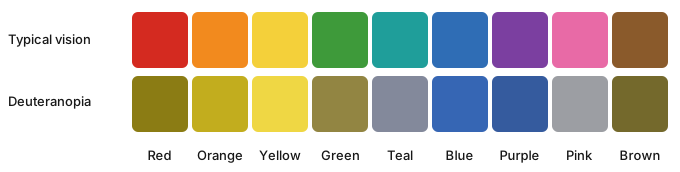
- Red, orange, yellow and green look like shades of the same yellow-brown hue.
- Blue and yellow are still seen clearly.
- Some pinks and purples look gray or blue.
Try our color blind simulator to see your own photos the way someone with a deutan deficiency might.
How common is deuteranopia?
About 1% of men; very rare in women.
Everyday situations that can be tricky
- Traffic lights are usually recognized by position rather than color.
- Color-coded information (charts, wires, map lines) often needs labels or patterns.
- Some careers require normal color vision tests, e.g. certain pilot, rail or electrical roles.
Causes
Inherited on the X chromosome. It is lifelong and stable.
Deuteranopia vs protanopia
Both are dichromacies with only two working cone types, and both make red, orange, yellow and green hard to tell apart. The main difference is brightness: in protanopia the red-sensitive cones are missing, so reds look much darker; in deuteranopia the green-sensitive cones are missing and reds keep roughly their normal brightness. Compare the two sets of simulated images.
Read more about protanopia.
Glasses, apps and other aids
Color-enhancing glasses rarely help with deuteranopia because a whole cone type is missing; there is no red-green signal for the filter to boost. What the studies found, type by type: do color blind glasses work?
Phone and computer accessibility settings (color filters), color-identifier apps, and asking for labels or patterns on color-coded information can all help. There is currently no approved cure for inherited color blindness.
How is deuteranopia diagnosed?
Eye care professionals use plate tests (such as Ishihara or HRR plates), arrangement tests and, for a precise diagnosis, an anomaloscope. Online tests like ours can flag a likely deficiency but can’t replace a clinical test.