Protanomaly
In protanomaly the red-sensitive (L) cones are shifted towards the green-sensitive cones. Reds look darker and less saturated, and red-green distinctions become harder. Severity ranges from mild to strong.
Protanomaly is the milder form of protan color blindness, often called red-weak color vision. The complete form is protanopia.
Red-green color vision deficiency · Last updated 2026-11-10
What does protanomaly look like?
 Typical color vision
 Simulated moderate protanomaly
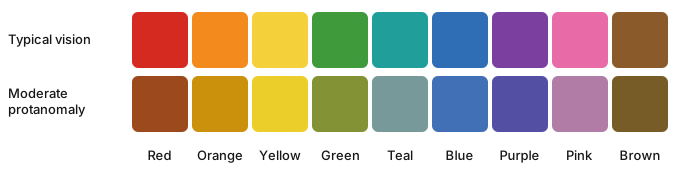
- Reds look darker, duller or more brownish than they do to most people.
- Red and green, and orange and yellow, can be confused.
- Deep red text on a dark background can be hard to read.
Try our color blind simulator to see your own photos the way someone with a protan deficiency might.
How common is protanomaly?
About 1% of men; rare in women.
Everyday situations that can be tricky
- Red warning lights and red laser pointers can be harder to spot.
- Red/green indicators on devices and charts.
- Distinguishing some purples from blues.
Causes
Inherited on the X chromosome (OPN1LW/OPN1MW genes). Present from birth and stable.
Protanomaly vs deuteranomaly
Both are anomalous (milder) red-green types. In protanomaly the red-sensitive cones are shifted, so reds also look darker; in deuteranomaly the green-sensitive cones are shifted and reds keep their brightness. Deuteranomaly is much more common, at about 5% of men compared with about 1% for protanomaly.
Read more about deuteranomaly.
Glasses, apps and other aids
Some people with protanomaly report better red-green contrast with color-enhancing glasses, though results tend to be weaker than for deuteranomaly. What the studies found, type by type: do color blind glasses work?
Phone and computer accessibility settings (color filters), color-identifier apps, and asking for labels or patterns on color-coded information can all help. There is currently no approved cure for inherited color blindness.
How is protanomaly diagnosed?
Eye care professionals use plate tests (such as Ishihara or HRR plates), arrangement tests and, for a precise diagnosis, an anomaloscope. Online tests like ours can flag a likely deficiency but can’t replace a clinical test.